


Slide listening (2017)
Instrumentation: concertino for piano and orchestra
Duration: about 9 minutes
Premiere: March 5th 2017 by the three finalists of Piano Campus international piano competition.
Orchestre Melodix, conducted by Fabrice Parmentier
National Theater of Cergy-Pontoise
Publisher : Éditions Musicales Artchipel
Commission: Pascal Escande for Piano Campus competition
Slide-listening est une pièce écrite pour piano et orchestre qui s’éloigne quelque peu de la forme classique du concertino dans le rapport entre le soliste et l’orchestre. Ici le discours ne s’établit pas au sein d’un axe confrontation/dialogue, mais plutôt dans une volonté d’orchestrer l’instrument soliste, de créer une sorte de piano augmenté par l’orchestre. Ce dispositif compositionnel filtré laisse s’échapper quelques résidus orchestrés et autres textures autonomes pensées comme des respirations d’ordre environnemental, proches du design sonore.
La forme et le matériau convergent dans la figure du glissement. Du glissement de l’archet sur les cordes au glissement de clusters diatoniques au piano, du glissement des flutes à coulisses au glissement de la superball sur le tam, du glissement d’objets musicaux au glissement des situations d’écoute, ces diapositives sonores s’entrechoquent à un tempo soutenu.
Cette pièce, créée par les finalistes du concours international Piano Campus 2017, met par ailleurs en jeu ce que j’appelle des OEM (objets esthétiquement modifiés) issus du concerto pour piano de Schumann (au programme de la finale). Les OEM sont des fragments musicaux issus de la littérature classique ou traditionnelle ; ces fragments sont, un peu à l’instar des manipulations génétiques, d’abord prélevés, décontextualisés, modifiés esthétiquement, puis confrontés à un nouvel environnement musical.
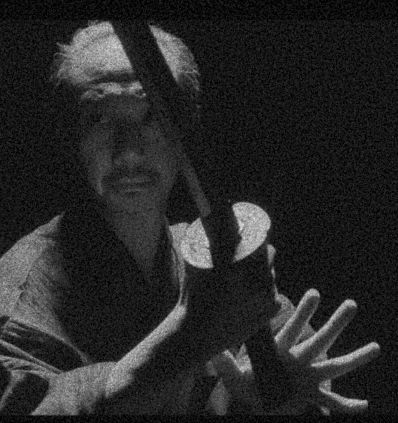

Kazegaku - 風楽 - (2026)
Noh singer, flutes, percussions, vocal ensemble
14 minutes
For Noh singer manipulating the sword, flutes (Nohkan or piccolo, C flute, and bass flute), percussion, and a 20-voice vocal ensemble.
Duration: 14 minutes
Commissioned by the Aedes Ensemble. Aide à la composition musicale du Ministère de la Culture et de la DRAC Hauts-de-France.
Dedication: to the memory of Akeji and for the twentieth anniversary of the Aedes Ensemble
Premiere on November 7, 2026, at the Atelier Lyrique de Tourcoing by Masato Matsuura, Mayu Sato, Eriko Minami, the Aedes Ensemble, conducted by Mathieu Romano.
Kazegaku (風楽) est un néologisme japonais que j’ai imaginé et qui peut se traduire par « musique du vent ». Cette pièce met en perspective cette figure, telle que considérée dans la cosmologie japonaise des cinq éléments (Godai - 五大), au sein de références multiples et d’une expérimentation sonore rendu propice par un dispositif singulier qui met en regard chant Nô et ensemble vocal occidental.
J’ai tenté de trouver des correspondances possibles à cette qualité particulière de la voix chantée Nô, à savoir la technique de Utaï, au sein du chœur et des instruments en présence. Ainsi, straubass et autres techniques comme une surpression de la langue sur le voile du palais, émission de souffles colorés, ou encore de saturations proches du vocal fry incarnent à la fois cette recherche et une forme poétisée et décalée de représenter le vent.
Formellement, cette nouvelle œuvre épouse un double mouvement qui se superpose. D’abord celui d’une traversée, d’une quête existentielle où l’on pourrait s’imaginer le parcours d’une vie, de l’enfance à la mort. Ensuite, celui d’une pensée plus fragmentaire et non linéaire, comme une cartographie d’instantanés musicaux d’essences différentes.
Pour réaliser cette multiplicité, j’ai convoqué plusieurs univers, appartenant à des degrés de réalité différents faisant référence au vent, afin d’écrire moi-même le livret, en langue française et en langue japonaise.
Le premier est celui du documentaire Akeji, le souffle de la montagne de Mélanie Schaan et Corentin Lecomte qui suit le quotidien du calligraphe Sumiyoshi Akeji à la fin de sa vie. Dans ce magnifique film, les éléments occupent une place centrale et le vent, comme une sorte d’écho des Kami, semble entrer en dialogue avec la routine hors du temps de ce descendant de Samurai.
Le deuxième est celui d’une nouvelle de Kenji Miyazawa, Kaze no Matasaburo qui relate l’histoire d’un petit garçon venu d’ailleurs qui arrive dans une école rurale, et où son passage bref, mystérieusement accompagné par le vent, laisse ses camarades hésiter entre réalité et légende. Des jeux de l’enfance à la peur de la disparition, le vent s’insinue partout et prend ici une place fantastique qui symbolise l’imaginaire singulier de cette période de la vie.
Le troisième est le Nô traditionnel Sesshō-seki, autour d’une mystérieuse pierre qui renfermerait l’esprit démoniaque d’un renard à neuf queues, où figure ce vers 風は大虚に渡る(Kaze wa Taikyo ni Wataru), Le vent traverse le grand vide.
Le dernier univers convoqué, bien plus sombre, est celui du souffle nucléaire, tant lié à l’histoire du Japon.
Ainsi, Kazegaku (風楽), en explorant l’écart entre représentations métaphoriques de matières sonores proches du vent et des perceptions temporelles qui s’affrontent, s’inscrit dans la continuité de mes recherches compositionnelles autour de la mise en tension de mon langage musical avec des ressources culturelles japonaises, axe de travail engagé depuis maintenant plus de quinze ans.
Kazegaku (風楽) is a Japanese neologism I coined, which may be translated as “music of the wind.” This piece explores that figure as understood within the Japanese cosmology of the five elements (Godai – 五大), drawing on multiple references and a sonic experimentation made possible by a distinctive setup that brings Noh chant into dialogue with a Western vocal ensemble.
I sought to find possible correspondences to the particular quality of the Noh singing voice—namely the utai technique—within the choir and the instruments involved. Techniques such as Straubass, as well as increased tongue pressure against the soft palate, colored breath emissions, and saturations akin to vocal fry, embody both this search and a poetic, displaced way of representing the wind.
Formally, this new work unfolds along a double movement that overlaps. The first is that of a journey, an existential quest that might evoke the course of a life, from childhood to death. The second is a more fragmentary, non-linear mode of thought, like a cartography of musical snapshots of differing essences.
To achieve this multiplicity, I drew on several worlds belonging to different degrees of reality, all referring to the wind, in order to write the libretto myself, in both French and Japanese.
The first is that of the documentary Akeji, le souffle de la montagne by Mélanie Schaan and Corentin Lecomte, which follows the daily life of the calligrapher Sumiyoshi Akeji at the end of his life. In this beautiful film, the elements play a central role, and the wind—like an echo of the kami—seems to enter into dialogue with the timeless routine of this descendant of samurai.
The second is that of a short story by Kenji Miyazawa, Kaze no Matasaburo, which tells of a young boy from elsewhere arriving in a rural school, whose brief passage—mysteriously accompanied by the wind—leaves his classmates wavering between reality and legend. From childhood games to the fear of disappearance, the wind permeates everything and takes on a fantastical dimension, symbolizing the singular imagination of that period of life.
The third is the traditional Noh play Sesshō-seki, centered on a mysterious stone said to contain the demonic spirit of a nine-tailed fox, in which appears the line 風は大虚に渡る (Kaze wa Taikyo ni wataru): “The wind traverses the great void.”
The final world invoked, far darker, is that of the nuclear breath, so deeply tied to the history of Japan.
Thus, Kazegaku (風楽), by exploring the tension between metaphorical representations of sound materials akin to wind and conflicting temporal perceptions, continues my compositional research into placing my musical language in tension with Japanese cultural resources—a line of work I have been pursuing for over fifteen years.